A Whiteparish local history page from younsmere-frustfield.org.uk
Blue links in the table below are available, links in purple have not yet been uploaded for public viewing
| All Saints Church | |
| Cowesfield Esturmy/Spilman/Louveras Chapel | shared between Cowesfield Esturmy, Louveras and Spilman |
| St Leonard, Whelpley | |
| Chapel of St James, Moore (Abbotstone) | |
| Cowesfield Spilman Chapel | |
| The Methodist Chapel (Wesleyan) | |
| The Old Methodist Chapel (Primitive) |
The part of Frustfield that is now Whiteparish was made up of four tithings, each with its own chapel, these being Alderstone, Whelpley, Abbotstone and Cowesfield; Landford occupied the remaining part of Frustfield. In the case of Alderstone the "chapel" is now the parish church. Whelpley Chapel was still in use as a chicken run when the author visited it in the 1990s. It still stands in 2020, but the roof has fallen in over the past 30 years. Abbotstone and Cowesfield chapels have long since vanished and we are not even certain exactly where they stood. Before considering these buildings and their history, as well as that of the other places of worship in the parish, is worth a brief aside to consider the wider history of Christianity in the area.
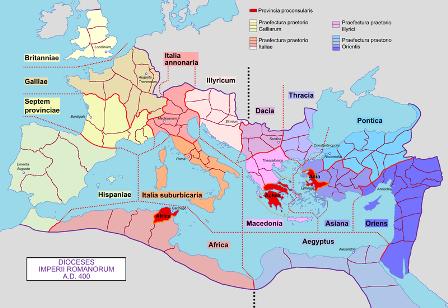
Christianity came to the British Isles under the Romans and by 400 the church in the Roman Empire was administered using the Civil Dioceses illustrated by the Wikepedia graphic shown below, taken from here. For an account of Christianity in the fourth century see here.
Civil Dioceses in the Roman Empire in 400 AD, on which Church Dioceses were based (Wikipedia, copyright: public domain)
larger image here
After the Romans left, the Saxons swept away Christianity in the areas they invaded, including in Hampshire and Wiltshire. After arriving at the head of Southampton Water in 495 [link], they reached Whiteparish later than 519, before or quite possibly as they took Old Sarum in 552. In Dorset, Devon, Somerset and Cornwall the earlier church structures continued under British rule, as well as for a time to the north of the Thames. The Saxons had been converted to Christianity by the time the Saxons took these areas, so that they have remained Christian from late Roman times to the present day.
37 years after the arrival of Augustine in Kent in 597 and disappointed with his lack of progress, Pope Honorius sent Birinus in 634 as new envoy, although without telling Augustine. Augustine was at the time disputing with the Celtic Bishops, who refused to acknowledge his claim to superiority. By this date the West Saxons and Gewissae had united into a single "kingdom", although, it seems, probably having several kings in different areas. Although Birinus had been intended to spread Christianity in the inner parts of Britain beyond the "Angles", judging the people of Wessex to be "paganissimo", or most confirmed pagans, he stayed to preach here. The following year King Cynegils was baptised by Birinus, by then styled as the Bishop of Dorchester, although Dorchester, in Oxfordshire, didn't remain in Wessex for long, and with the constant boundary disputes of the time was more usually in Mercia. Oswald, the King of Northumbria, was his godfather. Birinus maintained a very good relationship with the British bishops over a wide area (see here for a full account of the church in Wessex).
The church in Wessex expanded to included Sussex and was divided in 705 into the sees of Winchester and Sherborn, with the Forest of Selwood as the dividing boundary. Four years later in 709 the Winchester diocese itself was divided to split off the Sussex church under the bishop of Selsey. Two hundred years later, in 909, Winchester was divided into Winchester (Hants and Surrey) and Ramsbury (Wilts and Berks). At the same time Sherborn was divided into Sherborn (Dorset), Wells (Somerset) and Crediton (Devon), with the part of Wiltshire east of Selwood Forest (including Whiteparish) in Winchester. A final major reorganisation in 1075 decreed that bishops must be based in larger towns and cities. Ramsbury and Sherborn were combined as Sarum (Wilts, Berks and Dorset), and of course moved a few years later in 1218 from Old Sarum to New Sarum (Salisbury). Dorset was moved from Sarum to a new Bishop of Bristol in 1542, and then a series of changes in 1836 moved Berkshire into the Diocese of Oxford (effective from 1845), Gloucester and Bristol were united under one bishop, and Dorset was put back into Sarum. Roughly a third of Wiltshire was at the same time moved to the Bishop of Gloucester and Bristol.
During Saxon times the British had been pushed back as the Saxon kingdoms expanded, but the Celtic church survived in those areas remaining British. Wessex had converted to Christianity before finally starting to push westwards into Somerset and Dorset in 658, ensuring continuity of Christianity from Roman times west of the river Avon.
There is a reference often quoted from "Alfred the King", a novel by Patry Williams published by Faber & Faber in 1951, 336 pages, copyright Marguerite Patry. It is available in the Hampshire Record Office, on shelf 823 WILStack 2 Adult Fiction, Dewey Class 823 WIL. It is said to have an impressive list of genuine references, so it is possible that its mention of Whiteparish is based on documentary evidence. In it is the passage: "With spring the King and court moved to Leonaford (Landford). Round Leonaford were great forests and nearby at Whiteparish was a stone church [strictly should be Frustfield at that date, Whiteparish not having been used as a name until 1319 - Whytechurche from 1278]. If this is a genuine reference it could have referred to a number of possible buildings: the chapel of St Leonard at Whelpley, St James at Moore or Cowesfield chapel or an early church on the site of the present Whiteparish church. Further research is ongoing to establish whether this reference comes from a genuine historical source.
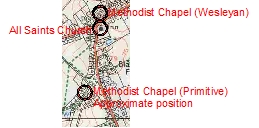

Maps showing the places of worship in Whiteparish
Of the early church in Whiteparish in Roman times or after the Saxon conversion in Whiteparish we know nothing, so must start our story with All Saints church in the centre of the village. Recorded first in 1276 [check], it contains a number of 12th century carved stones and some apparently earlier features. In all probability, there has been a church here for rather longer, with the chancel likely to represent the older part. Whelpley had a chapel (St Leonard) by 1318 and it remained in use until it was seized in 1547 at the Reformation (St Leonard, Whelpley). The author was invited to visit the building in about 1990, and at that time it was in use as a chicken run, and very kindly again in 2020, by which time only the walls and roof beams remained. There were two other chapels of similar size and status at Moore Farm (St James), and at Cowesfield Louveras [dedication not known?]. The chapels referred to as Cowesfield Spilman and Cowesfield Louveras were one and the same, sited in or near Chapel Field in Cowesfield Louveras near the present Rowdens Farm. Follow the links at the head of this page for further detail on individual buildings.
Also of interest in the history of the village are two Methodist Chapels. The one most recently in use in the centre of the village finally fell into disuse in the early years of the millenium, when the congregation became too few in number to support the expenses of the building. This chapel, labelled on the 1790 map as "Wesleyan", and an earlier one in Clay Street, labelled on the 1790 map as "Primitive" clearly served two congregations at the same time. Enough of our forebears were church and chapel goers to support two Chapels and the Anglican church at the end of the 18th century.
It is well to remember that All Saints Church was not always Anglican, [[[dates need checking and correcting and the story tidying up here... first changing from Roman Catholic in the reign of Edward VI (1547 to 1553), only to revert to Roman Catholic for 5 years (1547 to 1553) before settling down to its present Anglican status.]]]
The chapels at Whelpley and Moore were seized along with St Edmund's College, Salisbury in the King's name [Henry VIII] on the 16th and 17th June 1546, [?having been part of the endowment of the College]. Described as "free" chapels, these probably weren't chapels of ease to All Saints church. All three chapels were out of use after 1547 and only St Leonard's at Whelpley has survived to the present day.
Wiltshire Records Office has an entry for Baptists: In the return of 1669 a Baptist group is recorded in Whiteparish and these would have looked to the chapel at Downton as their 'mother church'. In 1715 the house of Christopher Biddlecombe was licensed for worship while the house of John Barling was licensed c.1716. The movement was not strong enough to build a chapel and individual Baptists probably worshipped at Downton in later years.
Wiltshire Records Office also has an entry labelled "Independents": In 1813 the house of Thomas Kener was licensed for worship while in 1832 a house occupied by John Wilson was licensed. Nothing more has been found on these small groups and they may have joined the Methodists later.
There is a further Wiltshire Records Office entry for the Plymouth Brethren: The Brethren seem to have first met in the house, now called The Cottage, next to the Fountain Inn in the early part of the 20th century. They later moved in the 1930s to a cottage near the school.
Of the Roman Catholics, the Wiltshire Records Office website merely says: There seems to have been one Catholic family in Whiteparish in the 16th and 17th centuries. Three people are recorded in 1676 but none in 1767. All Saints Church and its worshippers were Roman Catholic until 1534 and between 1553 and 1558 [see Wikipedia Church of England, Wikipedia First Statute of Repeal (Queen Mary I), Wikipedia Act of Uniformity 1558 (Queen Elizabeth I).
